
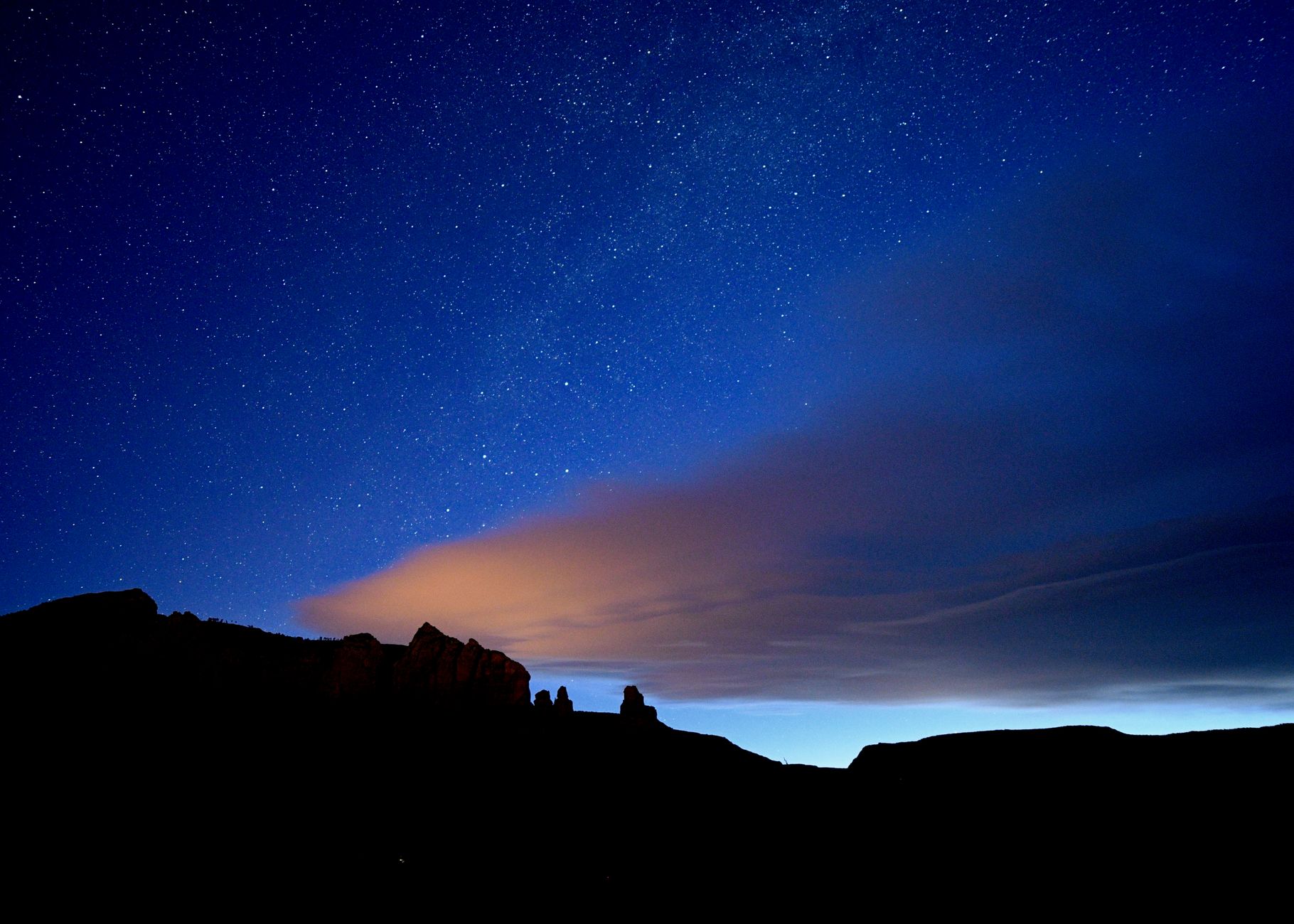
Sedona stargazing is the kind of thing that sounds like a cliché until you’re actually standing on a dark trail at 9pm watching the Milky Way arc over Capitol Butte. The red rocks get all the daytime attention, but once the sun drops, Sedona turns into one of the best places in the country to look up. Thin high-desert air, minimal humidity, and a small-town approach to outdoor lighting mean the sky here does something most visitors have never actually seen: it fills in, edge to edge, with stars.
Why Sedona Stargazing Is Actually Good
Sedona and the surrounding Verde Valley sit at roughly 4,350 feet, high enough to get above a good chunk of the atmospheric haze that washes out lower-elevation skies. Combine that elevation with low humidity and you get cleaner, steadier viewing most nights of the year. On top of that, Sedona has taken outdoor lighting seriously for decades. Local ordinances limit glare and unnecessary light spill, which is a big part of why the sky over the red rocks stays so much darker than what you’d get in a typical Southwest town of comparable size.
The result is a designated Dark Sky Community designation, one of a small number of towns in the country to earn that status. That’s not marketing language. It reflects real, measurable darkness, especially once you get a few minutes outside the main commercial strips.
Best Dark Sky Spots Around Sedona
You don’t need a permit or a guide to find good sky here. You need to get a little bit away from streetlights and give your eyes fifteen to twenty minutes to adjust. A few spots locals actually use:
Airport Mesa
Airport Mesa is the most obvious answer, and for good reason. The overlook near the top of Airport Road has wide open views in almost every direction, minimal tree cover, and enough elevation to get you above some of the ambient glow from town. It’s popular for sunset, which means it clears out fairly fast after dark, leaving you with a surprisingly open patch of sky and the silhouette of the red rocks around you.
Bell Rock and the Village of Oak Creek
The pullouts along Highway 179 near Bell Rock give you flat, easy parking and open desert in front of you instead of buildings. Because this area sits a bit south and away from Uptown’s concentration of lights, the sky here tends to be noticeably darker once you’re off the highway shoulder and out from under vehicle headlights.
Boynton Canyon
Boynton Canyon’s combination of high canyon walls and distance from town light creates real pockets of darkness, especially if you’re out past where day hikers turn around. It’s a longer walk in the dark, so this one is better suited to people who know the trail well or are comfortable navigating by headlamp.
Oak Creek Canyon
Heading north toward Flagstaff on 89A, Oak Creek Canyon’s steep walls block a lot of horizon light, and pullouts along the highway give you quick access without a hike. It’s a good option if you’re staying up canyon or want a stop on the way back from Flagstaff after dark.
West Sedona Neighborhoods
You don’t have to drive anywhere. Much of West Sedona, away from the main commercial corridor on 89A, has dark enough residential streets that a backyard or driveway view is legitimately worth a few minutes with your head tilted back, especially on a clear, moonless night.
What You’ll Actually See
This is the part people underestimate. On a clear, moonless night away from town lights, Sedona stargazing delivers more than a scattering of bright stars. You’ll typically see:
- The Milky Way as a visible band across the sky, not just a photo effect, especially in summer months when its core rises higher
- Constellations you can actually trace star to star, not just guess at, since the fainter connecting stars are visible here
- Planets like Jupiter, Saturn, Venus, and Mars, depending on the season, often bright enough to be the first “star” you notice
- Meteors during active showers like the Perseids in August or the Geminids in December, visible without any equipment
- The general glow of thousands more stars than most visitors have ever seen at once, which is usually the thing people mention first
You don’t need a telescope for any of this. Binoculars help pull in more detail on the Milky Way and star clusters, but naked-eye viewing here already outperforms what most people experience at home.
Best Time of Year for Stargazing in Sedona
Sedona’s four mild seasons all offer decent viewing, but a few windows stand out. Late spring through fall gives you warmer nights that make it comfortable to stay out longer, and summer is when the Milky Way’s core sits higher and brighter in the sky after dark. Winter nights are colder but often exceptionally clear, since there’s less moisture and dust in the air, and the sky can feel almost sharper. The one stretch to plan around is the July and August monsoon season, when afternoon and evening cloud buildup can roll in and block the sky, especially in the days around a storm system.
Whatever the season, check the moon phase before you head out. A full or near full moon will wash out fainter stars and the Milky Way, so the days around a new moon are consistently the best for serious Sedona stargazing.
Tips for Your Best Night Under the Stars
Give Your Eyes Time
It takes fifteen to twenty minutes for your eyes to fully adjust to darkness. Resist the urge to check your phone screen during that window, or you’ll reset the process.
Bring a Red Flashlight
A standard white flashlight or phone light will blow out your night vision and anyone else’s nearby. Red light settings, common on most headlamps, let you see the trail or your gear without ruining the view.
Check the Forecast and the Moon
Clear skies and a dark moon phase are the two things that matter most. A cloudy night or a bright full moon will flatten even the best viewing spot.
Dress for the Temperature Drop
Desert nights cool off fast, even after a warm day. Bring a layer you’d otherwise think is unnecessary.
Go a Little Off the Beaten Path
The busiest trailhead parking lots often have enough ambient light from cars and other visitors to dull the experience. A short walk past the crowd, or a quieter pullout a mile down the road, makes a real difference.
Sedona stargazing rewards almost no effort at all. Pick a clear, moonless night, drive ten minutes past the edge of town, and let your eyes adjust. Between the Dark Sky Community protections, the elevation, and the open desert horizon, this is one of the rare places where the sky above the red rocks is just as memorable as the rocks themselves.
Frequently Asked Questions
Is Sedona a certified Dark Sky Community?
Yes, Sedona has been designated a Dark Sky Community, reflecting local lighting ordinances that limit glare and light spill so the night sky stays significantly darker than in comparably sized towns.
What is the best time of year for stargazing in Sedona?
Late spring through fall offers warmer, comfortable nights, and summer brings a higher, brighter view of the Milky Way’s core. Winter nights are often the clearest overall, though colder, while the July and August monsoon season can bring cloud cover that blocks viewing.
Do I need a telescope to see stars in Sedona?
No, naked-eye viewing in Sedona already reveals the Milky Way, major constellations, and visible planets on a clear night. Binoculars can enhance detail, but they are not required for a great experience.
Where are the best spots near Sedona for stargazing?
Airport Mesa, the Bell Rock pullouts near the Village of Oak Creek, Boynton Canyon, and Oak Creek Canyon are all popular, along with quieter residential streets in West Sedona away from the main commercial corridor.
Get the Local’s Guide to Sedona
Every week we send the best of Sedona and the Verde Valley: the trails worth the drive, where the locals eat, and what is happening around town. Join free.
